Aug 30 - Trafalgar, Eliza Doolittle, Beatles, Sherlock, and more
Trafalgar Square, the largest square in London, is often considered the
heart of the city. Ever since the Middle Ages, Trafalgar Square has been
a central meeting place. At the middle of the square stands a tall
column honoring admiral Nelson. The column is guarded by four lion statues at its base.
 |
| A giant blue rooster is unveiled in central London's Trafalgar Square on July 25, 2013. WHAT? Do you call this a giant? Just wait til the next photo. |
 |
| "Hahn/Cock" - He is such an ultramarine blue color - it's getting a lot of attention. |
The square is also used for political demonstrations
and community gatherings, such as New Year's Eve.
The name commemorates the
Battle of Trafalgar, a British navel victory of the Napoleonic Wars over France
which took place in 1805. Both ultramarine blue and the rooster are symbols of France, which is a kind of humorous side-effect with this artistic feature.
 |
| Overlooking the square with King George IV on his horse in the background. |
In 1812 the Prince Regent - who would later become King George IV - asked architect John Nash to redevelop the area.
George IV did not want Britain to be left behind (many other cities in Europe had famous art galleries), so in 1824 he pushed a
reluctant government into purchasing the house of the just deceased John
Julius Angerstein, a rich Russian banker and art collector. The
purchase included a valuable collection of 34 paintings with works from
renowned artists such as Rembrandt and Rubens.
Over the years the collection expanded to one of the most prestigious in
Europe. Over 2300 paintings are now on display in the monumental
building at Trafalgar Square.
AND...to visit is FREE! We really enjoyed it.
 |
| The National Gallery was completed in 1838 and is on the north side of the square. |
 |
| Another statue on Trafalgar Square |
 |
| ...and another view from the Square |
Covent Garden is one of the London's biggest tourist magnets. The area
around the glass-covered building - a former fruit and vegetable market -
is always crowded. I mostly went because it is an icon in one of my favorite musicals - "My Fair Lady."
"Wouldn't it be Loverly?" -sung in Covent Garden by Eliza Doolittle in 1964. I played the part back in 1992
 |
| Punch and Judy is a traditional, popular puppet show featuring Mr. Punch and his wife, Judy. |
 |
| I looked all over for a "flower market" but all I could find was an "apple market." |
 |
| We picked up a dish with shrimp and mussels over rice - Paella - so very good! |
We watched some entertainment and absolutely loved this string quartet -
"Lotus Classics." They had choreography and played tunes like
Eine Kleine Nachtmusik, Bolero, Vivaldi's
Winter, and
Mister Sandman. I really enjoyed them and had to buy their CD.
 |
| The violist came over and sang Danny Boy to Rich and flirted with him. |
St Martin-in-the-Fields is an English Anglican church at the
north-east corner of Trafalgar Square. It is dedicated to Saint Martin of Tours. There has been a
church on the site since the medieval period.
 |
| St. Martin's- in -the- Fields Whipping Post |

Since early in the 20th century, the church has been famous for its work with homeless people.
 |
| There are many plaques, crypts, and monuments of those who have passed on. |
 |
| The beautiful pipes for the organ |

On we go to
Abbey Road and the famous Beatles album cover. We both LOVE the Beatles music, so it was fun to see a few shops and to actually walk on the same "zebra crossing" that they walked for this photo.
Here we go! We're on Abbey Road and a few other people had the same idea as us - to get a photo.
 |
| OK - I'll be "Paul" - my favorite, cause he was so cute. |
 |
| This was a cool old church close to Abbey Road |
 |
| Here we are - 40 years later and The Beatles are still REALLY popular. |
One of Rich's favorite characters of all times is
Sherlock Holmes, so we thought about going to the museum and where is lived, but the line was too long and we changed our minds.
Holmes, who first appeared in publication in 1887, was featured in four novels and 56 short stories. The Guinness World Records
has consistently listed Sherlock Holmes as the "most portrayed movie character"
with more than 70 actors playing the part in over 200 films.
 |
| 221B Baker Street is the London address of the fictional detective Sherlock Holmes, created by author Sir Arthur Conan Doyle |
 |
| Hey - Where are his legs? |
Some more performers just earning a living on the streets of London.
Lisson Grove is a district and also a street of the City of Westminster, located just to the north of the city ring road. The journalist George Augustus Salas
recalls growing up in Lisson Grove during the 1830s "when the principle
public buildings were pawnbrokers, and 'leaving shops', low public
houses and beer shops and cheap undertakers."
 |
| I was there because that was where Eliza Doolittle was from. |
Sorry the video clip is sideways. :(
The fictional Eliza was born and raised in Lisson Grove and had to pay "four and six
a week for a room that wasn't fit for a pig to live in" before coming under the tutelage of Professor Henry Higgins. I had fun standing on the sidewalk and reciting some lines from "My Fair Lady." I got a lot of eyeballs watching. HA!
Her Majesty's Royal Palace and Fortress, more commonly known as
the
Tower of London, is a historic castle on the north bank of the River
Thames.
 |
| The castle was used as a prison from 1100 until 1952,
although that was not its primary purpose. |
It was founded towards the end of 1066 as part of the Norman Conquest of England. The White Tower, which gives the entire castle its name, was built by William the Conqueror 1078, and was a resented symbol of oppression, inflicted upon London
by the new ruling elite.

 |
| This group of ladies wanted their picture taken. Love their outfits. |
A grand palace early in its
history, it served as a royal residence. As a whole, the Tower is a
complex of several buildings set within two rings of
defensive walls and a moat.
 |
| The Tower with the River Thames and Tower Bridge to the south. The outer curtain walls were erected in the 13th century. |
 |
| Modern modern modern! |
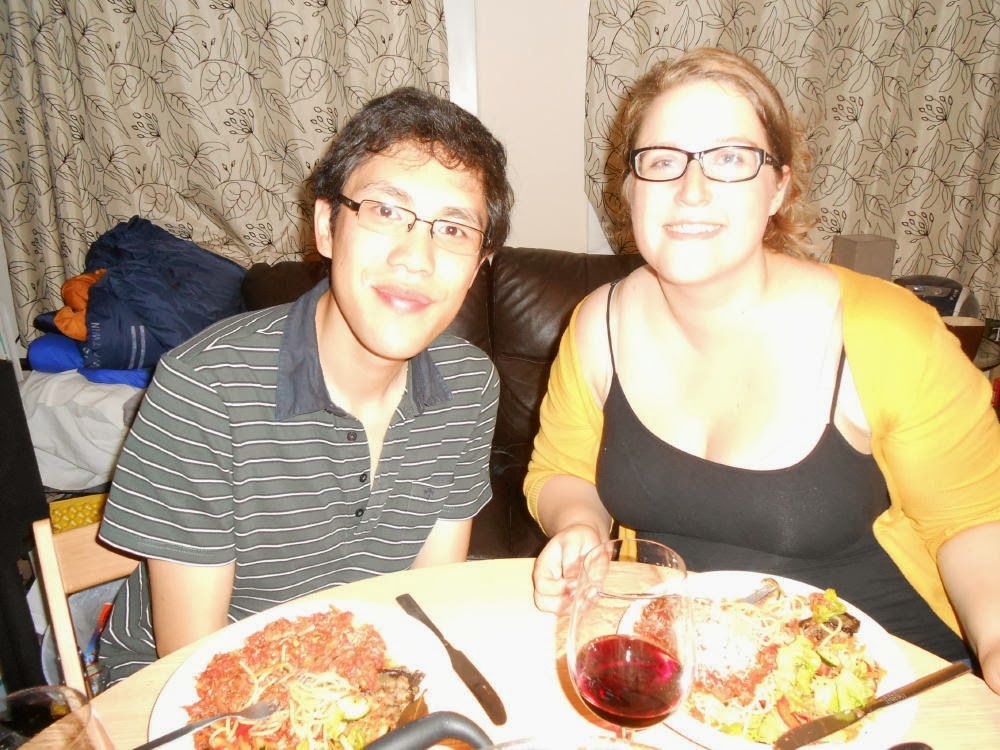
We got back to our host's home and cooked together. Pasta, vegetables, eggplant, salad - YUM!
 |
| Mark & Julia - He was an organist and she was a social worker. |
 |
| 99% of people in Europe don't have clothes dryers, so the rack is what they use. |
 |
| Rich was on the floor and I was on the couch. |
We had 3 days and nights in London trying to do as much as we could. We definitely didn't see it all, but we tasted as much as we could of London, listened to as much as we could, and saw as much as we could. It was definitely a different world. One to remember for a LONG time.